Article: Silver, Ian A. 2026 “Criminal Legal System Involvement During Adolescence as a Social Determinant of Adulthood Body Mass Index?” Journal of Adolescent Health. https://doi.org/10.1016/j.jadohealth.2026.07.022
1. Background (PDF)
Body mass index (BMI) is the ratio of an individual’s weight to height and has been correlated with factors that could contribute to health more generally (e.g., food insecurity). While genetic factors do contribute to BMI, evidence suggests that certain environmental factors could be classified as social determinants of adulthood BMI. Research to date points to adolescence as a key period of time where environmental factors could shape BMI throughout the life course. However, no prior research has considered criminal legal system (CLS) contact during adolescence (before 18) as a potential social determinant of adulthood BMI.
This study is the first to examine whether being arrested, incarcerated in a juvenile facility, or incarcerated in an adult facility before 18 is associated with BMI from 2003 to 2021. Prior research illustrates that incarcerated youth tend to gain weight while confined. One study found the percentage of youth with high BMI in a juvenile facility rose from 38% at intake to 66% after just three months, likely tied to institutional diets and reduced physical activity. Youth CLS involvement could decrease adulthood BMI by contributing to food insecurity, unstable housing, and constrained health care access. Alternatively, youth CLS involvement could increase adulthood BMI by promoting high calorie diets and the usage of food/drinks as behavioral incentives.
2. Results
Using the National Longitudinal Survey of Youth 1997 (NLSY97) and a quasi-experimental design, the study found:
- Youth CLS involvement was associated with lower yearly BMI in adulthood. Compared to youth with no CLS contact, average yearly BMI from 2003–2021 was lower among youth who were: Arrested before 18, incarcerated in a juvenile facility before 18, and incarcerated in an adult facility before 18
- The gap in BMI widened over time between youth with CLS involvement and youth without CLS involvement. Youth arrested or incarcerated in juvenile facilities before 18 gained BMI more slowly each year than youth without CLS contact, meaning the disparity grew across adulthood. Youth incarcerated in adult facilities had the lowest BMI overall but grew at a similar rate to non-involved youth.
- Severity of involvement mattered. Youth incarcerated in adult facilities showed the largest and most persistent BMI reductions, consistent with theory suggesting more severe CLS contact carries greater collateral consequences (e.g., higher exposure to abuse, greater disruption to schooling and family life).
In conjunction with the existing research on BMI during confinement, this research suggests that while youth might gain body mass during CLS involvement, their body mass is lower than their peers without CLS involvement before 18.
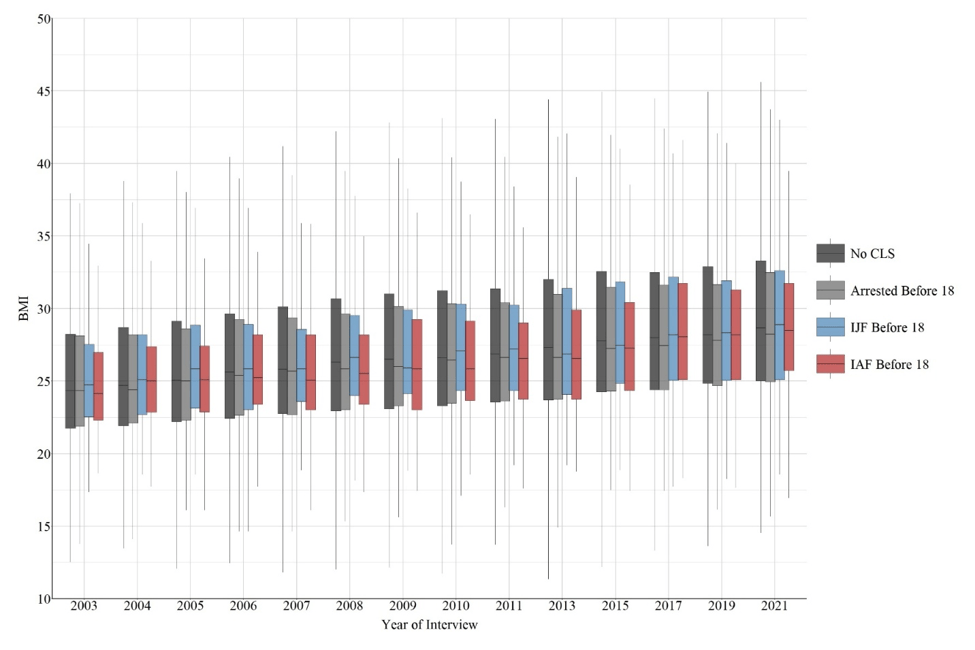
Notes: “CLS” = Criminal Legal System; “IJF” = Incarcerated in Juvenile Facilities, “IAF” = Incarcerated in Adult Facilities; “BMI” = Body Mass Index. No CLS contact N = 7,356; Arrested Before 18 N = 1,317; Incarcerated in Juvenile Facilities Before 18 N = 179; Incarcerated in Adult Facility Before 18 N = 109. See Appendix A for CLS contact before 18 group means and standard deviations by year.
3. Implications
A lower BMI should not be read as a sign of better health. Existing research consistently shows that formerly CLS-involved youth face disadvantages during reentry (e.g., housing insecurity), have worse mental/physical health, are less likely to have health insurance, and are less likely to engage in preventive care than their peers. As such, lower BMI in this population likely reflects food insecurity, unstable housing, substance use, and untreated health conditions rather than the maintenance of healthy body weight.
For juvenile justice and reentry practitioners, this points to the years immediately following arrest, release, or discharge as a critical window for connecting youth to food assistance (e.g., SNAP), health care navigation, and stable housing supports. As such, practitioners should screen and address food insecurity, substance use, and untreated health conditions during reentry.
For policymakers, the findings support continued investment in food security programs and behavioral health services targeted at justice-impacted youth as they transition into adulthood, alongside the health insurance and employment supports highlighted in related work on this population.
4. Data and Methods
The study used the NLSY97, a nationally representative U.S. birth cohort of 8,984 individuals born between 1980 and 1984. The analytical sample included 8,961 individuals who were under 18 at the 1997 baseline interview. CLS involvement before age 18 (arrest, juvenile facility incarceration, adult facility incarceration, or no contact) was based on self-reported data collected from 1992–2002. BMI was calculated annually from 2003–2021 using self-reported height and weight.
Gradient boosted inverse probability weights (an Average Treatment Effect approach) were used to balance 24 confounding variables — including pre-CLS BMI, health insurance status, general health, family background, and childhood adversity — across the four CLS groups. These weights were applied in random intercept and random intercept growth curve models predicting yearly BMI. Missing data were addressed using random forest imputation.
5. Conclusion
Contrary to expectations based on short-term weight gain during confinement, this study finds that CLS involvement before age 18 is associated with lower BMI across adulthood, with the largest reductions among youth incarcerated in adult facilities. Given this population’s well-documented health and economic disadvantages, these findings likely reflect food insecurity and reduced caloric intake rather than improved health. Practitioners and policymakers should treat this as a marker of unmet needs and prioritize food security and health care access during the reentry.
Disclosure: This research brief was drafted by Claude and revised by Ian A. Silver.

