Article: Silver, Ian A., D’Amato, Christopher, and Wooldredge, John. 2021. “The cycle of reentry and reincarceration: Examining the influence on employment over a period of 18 years.” Journal of Criminal Justice 74: 101812. https://doi.org/10.1016/j.jcrimjus.2021.101812
1. Background (PDF)
Roughly 600,000 individuals leave prison and millions more leave local jails to reenter society each year. Reentry is commonly treated as a single event, yet formerly incarcerated individuals face a heightened likelihood of returning to confinement, creating the reentry-reincarceration cycle. Briefly, the reentry-reincarceration cycle is where an 1) individual becomes incarcerated, 2) reenters the community, 3) becomes reincarcerated due to the situational circumstances surrounding reentry, and 4) has to do it all over again upon release. While many reasons exist for why individuals break the reentry-reincarceration cycle, it often coincides with treatment (e.g., cognitive behavioral therapy) and decreased barriers to reentry (e.g., employment).
An important barrier to reentry is the increased difficulty associated with finding and keeping legal employment. This study examines if the cycle of reentry-reincarceration exists and influences employment over the life-course. We explicitly asked 1) do formerly incarcerated individuals experience a cycle of reentry-reincarceration? 2) Does the number of months an individual is incarcerated each year predict between-individual employment outcomes the following year? 3) Does the within-individual change in the number of months incarcerated over time predict the within-individual change in employment outcomes the following year? Answering these questions provided a better understanding of the reentry-reincarceration cycle and the effects on employment.
2. Results
The study produced four key findings: First, the number of months an individual spent incarcerated in one year predicted the number of months incarcerated the following year, providing evidence supporting the existence of the reentry-reincarceration cycle. Second, compared to individuals who spent less time incarcerated, spending more months incarcerated in a specific year was associated with fewer weeks employed the following year. For example, more time spent incarcerated in 2003 was associated with a reduction in weeks employed in 2004. However, no association was observed with employment status (employed vs. not employed).
Third, an individual experiencing more time incarcerated was associated with the decreased likelihood of employment and number of weeks worked across the life-course for that individual. Fourth, employment itself functioned as a protective factor: individuals who were employed or who worked more weeks in a given year were subsequently less likely to spend time incarcerated the following year. Together, these findings suggest that incarceration diminishes future employment, but employment helps guard against future incarceration (see Figure 1).
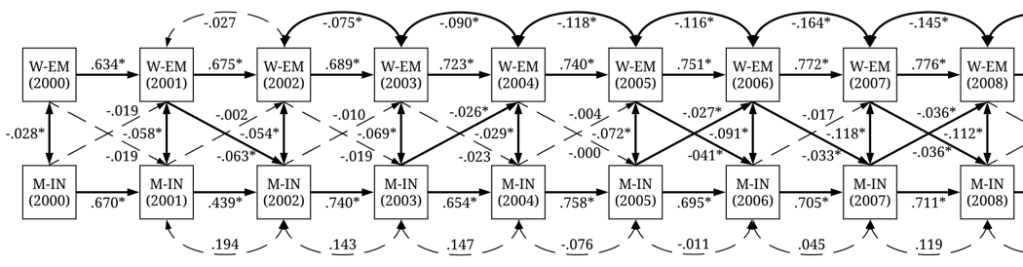
Notes: Solid arrows = stability over time within the same construct; dashed arrows = cross-lagged (negative) effects between incarceration and employment. Adapted from the cross-lagged panel models reported in the original study (Figs. 2).
3. Implications
The findings call for viewing incarceration and reentry as a recurring cycle rather than a single event, with corresponding shifts in policy and practice. For policymakers, the research suggests that investments in helping individuals obtain and, importantly, maintain employment after release may reduce the likelihood of an individual becoming reincarcerated during reentry. Adult correctional departments, aligned with this evidence, should consider expanding vocational and employment programming, as the costs of these programs will likely be offset by the high cost of individuals cycling through the criminal legal system. Additionally, building formal partnerships between correctional agencies and employers willing to hire formerly incarcerated individuals may help reentering individuals find high quality jobs.
4. Data and Methods
The study analyzed data from the National Longitudinal Survey of Youth 1997 (NLSY97), a nationally representative cohort of 8,984 individuals born between 1980 and 1984 and interviewed annually (later biennially) from 1997 through 2017. Because employment questions were only asked of respondents 14 and older, the analytical window ran from 2000 through 2017. After listwise deletion, the analytical sample comprised 4,705 respondents with complete monthly incarceration and weekly employment histories; of these, 345 individuals were incarcerated for at least one month during the study period.
The key time-varying measures were (1) the number of months incarcerated in a given year (0–12), and (2) two employment outcomes – whether the respondent was legally employed at any point during the year, and the number of weeks employed that year (0–52/53). Four time-stable covariates were included: sex, Black or Hispanic ethnic/racial background, cognitive ability (ASVAB percentile), and months incarcerated prior to the study window (1992–1999).
Two complementary longitudinal strategies were used. 1) Bivariate cross-lagged panel models examined between-individual effects, using each year’s number of months incarcerated to predict the following year’s incarceration and employment (and vice versa), adjusting for stability over time. 2) Lagged conditional latent growth models examined within-individual effects by modeling each respondent’s own trajectory (intercept and slope) of incarceration and testing whether it predicted that same respondent’s trajectory of employment. Models for the dichotomous employment outcome used diagonally weighted least squares; models for weeks employed used maximum likelihood estimation with robust standard errors. Missing-case analyses, and replications using full-information maximum likelihood and multiple imputation, indicated the results were not substantially altered by missing data.
5. Conclusion
This study provides evidence that incarceration and reentry function as a cycle rather than isolated, one-time event, and that the cycle of reentry-reincarceration has measurable consequences for employment across the life-course. Individuals who spend more time incarcerated experience corresponding declines in employment and weeks worked. Additionally, employment helps protect against future incarceration. These results reinforce the case for treating employment support as a core part of reentry and correctional policy. Future research using more granular (e.g., daily) incarceration data, separating jail from prison stays, and accounting for local labor-market conditions could sharpen understanding of exactly when and how intervention is most likely to break the cycle.
Disclosure: This research brief was drafted by Claude and has been reviewed by Ian A. Silver.

