Full Article: Silver, I. A., D’Amato, C., Newsome, J., Johnson, S., & Rubenstein, B. (2023). Forecasting the potential effects of programming combinations for justice-involved youths. Journal of Criminal Justice, 88, 102093. https://doi.org/10.1016/j.jcrimjus.2023.102093
1. Background (PDF and Publication)
Approximately 800,000 youth are processed through the juvenile justice system in the U.S. each year, with many serving sentences in residential correctional facilities. These youth often have a diverse set of criminogenic needs, including substance use, aggression, antisocial thoughts, and antisocial peer influences. As such, practitioners are often tasked with providing services to youth that align with their criminogenic needs to promote rehabilitation and success during reentry. The provision of services can involve a youth being assigned to participate in one program or multiple programs to address the distinct criminogenic needs being exhibited by the individual. While the effectiveness of individual programs has been studied extensively (e.g., cognitive behavioral therapy), research has rarely considered examining the impact of programming combinations on rehabilitation. The current study sought to address this gap by assessing if differences in the combination of programs a youth participated in could lead to unique effects on future contact with the justice system. Understanding if certain programming combinations have a distinct influence on recidivism is critical for advancing the development of individualized case plans for youth during confinement and upon reentry and is imperative for advancing both case planning policy and practice for adjudicated juveniles.
2. Summary of Findings
The results of the study revealed that there were differences in the forecasted probability of future contact with the criminal justice system depending upon the programming combinations assigned to 1,000 identical hypothetical cases (100 cases assigned to each CCF [50 moderate risk and 50 high risk cases on the OYAS]). The results revealed that each programming combination was forecasted to impact the future likelihood of contact with the justice system differently. Some programming combinations did appear to be associated with further reductions in the future likelihood of contact with the justice system when compared to exposure to a single program or not being exposed to any programs. Although rare, some programming combinations did appear to increase the future likelihood of contact with the justice system when compared to not being exposed to any programs. The majority of programming combinations appeared to have a similar effect on the future likelihood of contact with the justice system when compared to being exposed to a single program or slightly lower when compared to not being exposed to any programs. Figure 1 provides a visual example of the forecasted effects of Thinking For A Change in combination with other programs on contact with the criminal justice system.
3. Implications
The findings have several key implications for programming decisions and, more importantly, case planning for youth.
1. First, and foremost, individualized case planning for youth confined within juvenile justice facilities is imperative as the services provided to a youth could have unique effects on future contact with the criminal justice system. Additionally, case planning provides an opportunity to track the programming combinations provided to a youth and can be used to assess if certain programming combinations are achieving the desired recidivism reduction effects upon reentry.
2. Second, when case planning, practitioners should be intentional about the programs provided to the youth, considering that placement in more programs does not always lead to a reduction in recidivism. Assigning an individual to one combination of programs might increase the future likelihood of contact with the justice system, while assigning an individual to another combination of programs might lead to reductions in recidivism. Furthermore, case plans should focus on placing youth into programs that target the criminogenic needs of the individuals, as they could result in greater recidivism reducing effects when combined together.
3. Finally, facilities should continuously conduct evaluations to assess that the case plans and programming combinations provided to youth within their facilities are achieving the desired recidivism reduction effects upon reentry. While evidence-based case planning is imperative to selecting programs for youth that could potentially reduce criminogenic needs, unique programming combinations – including combinations not examined here –could result in distinct effects on recidivism and, in turn, require additional research to reveal the unique effects of each programming combination.
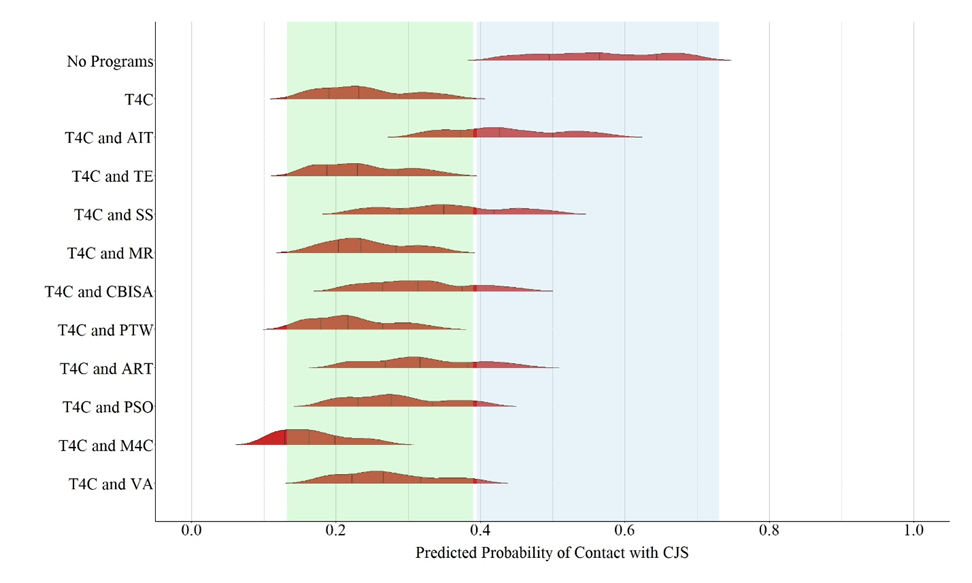
Figure 2: Forecasted Impact of Thinking For A Change in Combination with the Specified Program on Contact with the CJS.
Notes: Blue shared area provides the ability to compare the predicted probability of contact with the CJS for each program to the predicted probability of contact with the CJS for the no programming group. Green shared area provides the ability to compare the predicted probability of contact with the CJS for each program to the predicted probability of contact with the CJS for exposure to T4C only. “T4C” = Thinking for a change; “AIT” = Aggression Interruption Training; “TE” = Thinking Errors; “SS” = Skill Streaming; “MR” = Moral Reasoning; “CBISA” = Cognitive Behavioral Intervention Substance Abuse; “PTW” = Pathways; “ART” = Aggression Replacement Training; “PSO” = Pathways Sex Offender; “M4C” = Motivation for Change; “VA” = Victim Awareness. Predictions based on 1000 identical youth.
4. Data and Methods
The study analyzed data from 681 youths released from 10 Ohio Juvenile Community Corrections Facilities (CCFs) prior to July 1, 2015, all of whom had complete records on group-based programming and were eligible for a full 3-year post-release recidivism follow-up. The analysis focused on exposure to 11 group-based treatment programs commonly implemented across CCFs:1) Thinking for a Change, 2) Aggression Interruption Training, 3) Thinking Errors, 4) Skill Streaming, 5) Moral Reasoning, 6) Cognitive Behavioral Intervention-Substance Abuse, 7) Pathways, 8) Aggression Replacement Training, 9) Pathways for Sex Offenders, 10) Victim Awareness, and 11) Motivation for Change. Recidivism was the primary outcome, operationalized as any adjudication in juvenile court or incarceration in either juvenile or adult correctional facilities within three years of release. The model adjusted for key covariates including criminogenic risk (based on the Ohio Youth Assessment System – Residential tool), age at admission, sex, race/ethnicity, prior mental health diagnosis, receipt of family visitation, offense type (sex offense or not), and length of stay in the facility.
A Bayesian random intercept generalized linear model (RI-GLM) was employed to account for clustering within facilities and estimate the relationship between program exposure and recidivism. The model used weakly informative priors and was estimated using Markov Chain Monte Carlo simulations with four chains and 20,000 iterations via the brms package in R. Model fit was assessed using Rhat, ESS, and leave-one-out cross-validation. Posterior predictions were then generated for 1,000 hypothetical moderate or high-risk Black male youths to forecast the probability of recidivism under different programming conditions. These simulations allowed for the estimation of program effects while accounting for uncertainty in the model’s parameters.
Disclosure: This research brief was prepared by ChatGPT and edited by Ian A. Silver PhD.

