Ian A. Silver, Daniel C. Semenza, and Joseph L. Nedelec
1. Background (PDF and Publication)
Incarceration is associated with a range of negative outcomes, including diminished physical and mental health, increased exposure to violence, substance use, and elevated mortality risk. While prior research has documented the health impacts of incarceration broadly, there has been relatively limited focus on how these risks manifest among youths incarcerated in adult correctional facilities.
In the U.S., laws in many states allow juveniles—defined as individuals under 18 years of age—to be tried and sentenced in adult criminal courts, leading to detention in adult prisons. These environments often lack the rehabilitative services found in juvenile facilities and expose young people to harsher conditions, including threats of violence and diminished access to education and counseling. The published study explored if incarceration in adult facilities before 18 was associated with premature death in early adulthood.
2. Findings
Early adult incarceration was associated with premature death. Youths incarcerated in adult facilities before age 18 had a 33% higher risk of dying between ages 18 and 39 compared to those with no legal system contact (Time Ratio [TR] = 0.67; 95% CI: 0.47–0.95). Youths who were arrested but not incarcerated in adult facilities before age 18 also had a statistically significant increased risk of death (TR = 0.82; 95% CI: 0.73–0.93). However, the number of arrests or months incarcerated in adult facilities did not independently predict mortality once incarceration itself was accounted for. General health in adolescence was protective, while being male and having a parent incarcerated before age 16 increased mortality risk. These findings were observed while adjusting model estimates for measures approximating socioeconomic status, childhood adversity, race/ethnicity, and respondent health before 18. Figure 1 provides a visual display of the cumulative probability of dying for those youth: 1) incarcerated in adult facilities before 18, 2) arrested before the age of 18, and 3) had no criminal legal system contact before the age of 18.
3. Implications
The study’s findings underscore the potentially life-shortening impact of incarcerating youths in adult correctional facilities. The elevated mortality risk persists even after adjusting for multiple confounding factors, suggesting that the experience of incarceration in adult settings may contribute to harmful outcomes. Stakeholders should potentially reevaluate laws that allow juveniles to be transferred to adult court and incarcerated in adult prisons, as well as consider the life course impact of transfers to the adult system when pursuing cases against system involved youth. Furthermore, efforts should be made to enhance the protections and health related support services for justice-involved youth placed in adult correctional facilities – jails and prisons. Increasing health services before, during, and after confinement could also potentially prove fruitful in addressing the health and social needs of adolescents incarcerated in adult facilities. The authors emphasize that while causality can not be established, the findings suggest that attention should be placed on the extralegal harms of youth incarceration in adult facilities and provide evidence suggesting that reform could lead to superior outcomes for youth involved in the criminal legal system.
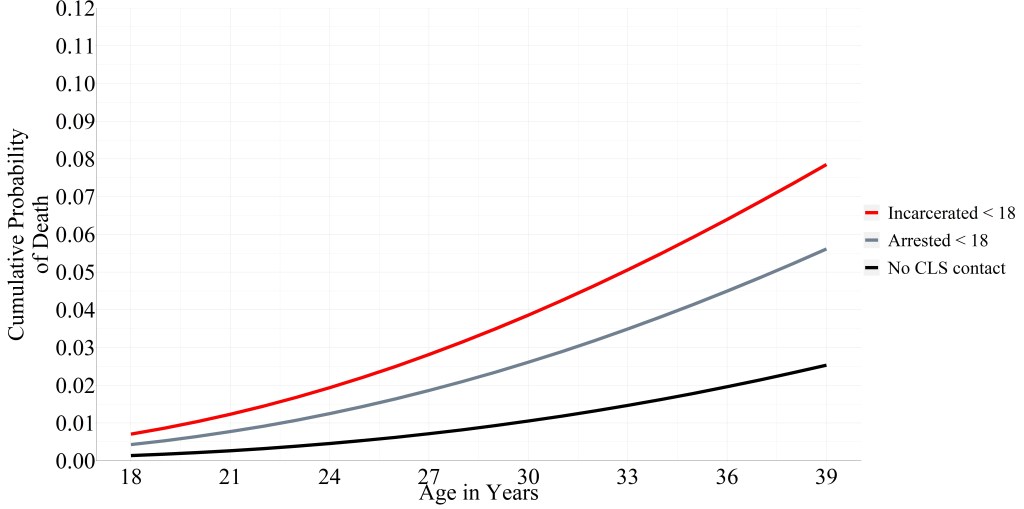
Notes: The cumulative probability of dying by the corresponding age was estimated using the results from the model presented in Table 2. Incarcerated <18 indicates ever spending time in an adult correctional facility as a youth. CLS indicates criminal legal system.
4. Data and Methods
This cohort study utilized data from the National Longitudinal Survey of Youth–1997 (NLSY97), which tracked a nationally representative sample of individuals from adolescence into adulthood. Sample: 8,951 individuals born between 1980 and 1984 who were 17 or younger in 1997 and survived to their 18th birthday. Data collection: Annual interviews from 1997 to 2011, then biennial interviews through 2019, totaling 19 interview waves. Independent variables of interest included incarceration in an adult facility and arrest before age 18. The dependent variables of interest was time until death from 18 to 39 years. The covariates included demographic variables, parental incarceration, childhood adversity, health status, and socioeconomic indicators
Parametric survival model using a lognormal distribution were used to estimate the effects of incarceration in an adult facility and arrest before age 18 on time until death from 18 to 39 years. This approach was selected after testing for violations of the Cox proportional hazards assumption. Results are reported as Time Ratios (TR), where values <1 indicate higher mortality risk. To address missing data, the authors used multiple imputation techniques. Supplemental models confirmed that the relationship between adult incarceration and early death persisted even after accounting for juvenile facility incarceration.
5. Conclusion:
This study offers evidence that incarcerating youths in adult correctional facilities is associated with an increased risk of premature death, independent of other legal, demographic, and health-related risk factors. These findings contribute to a growing body of research suggesting that youth experience negative outcomes when incarcerated in adult facilities, contributing to calls for reform in policies associated with the transfer of juveniles to the adult correctional system.
Author Affiliations:
Ian A. Silver PhD; Center for Legal Systems Research, RTI International, Research Triangle Park, NC, USA.
Daniel C. Semenza PhD; Department of Sociology, Anthropology, and Criminal Justice, Rutgers University, Camden, NJ, USA; Department of Urban-Global Public Health, School of Public Health, Rutgers University, Piscataway, NJ, USA; New Jersey Gun Violence Research Center, Rutgers University, Piscataway, NJ, USA
Joseph L. Nedelec PhD; School of Criminal Justice, University of Cincinnati, Cincinnati, Oh, USA.
Disclosure: This research brief was prepared by ChatGPT and reviewed/edited by the authors.
 ianasilver.com