Article: Silver, Ian A., Dole, Jenna, L., and Bechtel, Kristin. 2026. “Is youth criminal legal system involvement a risk factor for adulthood homelessness?: A quasi-experimental examination.” Journal of Criminal Justice. 102626. https://doi.org/10.1016/j.jcrimjus.2026.102626
1. Background (PDF)
Individuals involved in the criminal legal system (CLS) before age 18 face a variety of collateral consequences when reentering the community. These consequences can include, but are not limited to, restrictions on housing eligibility, employment, access to health care and insurance, and student loans, as well as stigma and strained family relationships. While research has documented the health, educational, and economic consequences of adolescent CLS involvement, comparatively little attention has been paid to its effects on housing stability in adulthood.
Homelessness is a growing public health concern in the United States. As of January 2023, more than 653,000 individuals were identified as experiencing homelessness on a single night – a 12 percent increase from the previous year. Youth and young adults are disproportionately affected, with an estimated 4.2 million people experiencing homelessness each year. Black and Brown youth and adults are overrepresented in both the CLS and the homeless population. Despite the well-established link between adult incarceration and housing instability—often described as a revolving door between the CLS and homelessness—far less research has examined this relationship for those who first encountered the system as children. This study addresses that gap by investigating whether, and through which pathways, CLS involvement before age 18 predicts homelessness during early and later adulthood. It is the first study to causally evaluate the distinct effects of three levels of CLS severity—arrest only, incarceration in a juvenile facility, and incarceration in an adult facility—on adulthood homelessness.
2. Results
Using rigorous causal methods, the study produced three key findings:
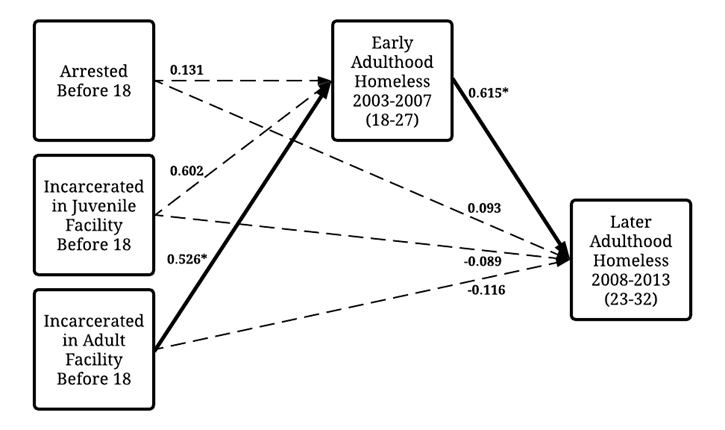
First, incarceration in an adult facility before age 18 was associated with a significantly higher likelihood of homelessness during early adulthood (2003-2007; 18-27). Being arrested before 18 or incarcerated in a juvenile before 18 did not influence homelessness during early adulthood
Second, being arrested, incarcerated in a juvenile facility, or incarcerated in an adult facility before 18 did not have a total effect on homelessness during later adulthood (2008-2013; 23–32).
Third, incarceration in an adult facility before 18 was indirectly associated with later adulthood homelessness (2008-2013; 23–32) through the pathway of early adulthood homelessness (2003-2007; 18-27). Being arrested before 18 or incarcerated in a juvenile before 18 did not have an indirect effect on later adulthood homelessness (2008-2013; 23–32)
Together, these findings indicate that incarceration in an adult facility during adolescence elevate one’s risk of experiencing adulthood homelessness, and that experiencing homelessness during early adulthood influences housing insecurity during later adulthood (See Figure 1).
3. Implications
The results call for a coordinated response across juvenile justice, housing, and social service systems. For policymakers, the evidence supports efforts to reduce youth confinement, especially in adult facilities. Diversion programs, restorative justice approaches, and community-based alternatives to incarceration can interrupt the trajectory toward homelessness before it begins. Given that homelessness in early adulthood becomes a pathway to later housing instability, preventing initial episodes of homelessness at the point of reentry from the CLS is especially critical. Policies that currently bar individuals with CLS histories from accessing housing assistance programs should be revisited, as these exclusions may exacerbate the very outcomes they seek to avoid.
For juvenile justice practitioners, these findings underscore the importance of treating housing stability as a core component of reentry planning. CLS agencies involved in the supervision or confinement of youth under 18 should provide individualized treatment and case planning that address homelessness risk. Validated homelessness risk assessment tools could equip juvenile justice professionals with the information needed to connect youth to housing support before and after release. Transitional housing programs and rapid re-housing models—such as the Preventing Homelessness and Rapid Re-housing program—may offer particularly promising avenues for youth exiting the CLS.
4. Data and Methods
This study analyzed data from the National Longitudinal Survey of Youth 1997 (NLSY97), a nationally representative cohort of 8,984 individuals born between 1980 and 1984, interviewed annually from 1997 through 2021. The analytical sample comprised 8,961 individuals who were under age 18 at baseline.
The primary outcome was homelessness, measured across two time periods: early adulthood (2003–2007; 18-27) and later adulthood (2008–2013; 23–32). CLS involvement was categorized into four mutually exclusive groups: no criminal legal contact before 18, arrested only before 18, arrested and incarcerated in a juvenile facility before 18, and arrested and incarcerated in an adult facility before 18.
To estimate causal inferences, the study employed a two-pronged analytic strategy. First, Average Treatment Effect Inverse Probability Weights (ATE-IPWs) were estimated using gradient boosted models via the TWANG package in R, balancing the four CLS groups across 19 confounding variables. Second, a confounder factor model—an iteration of a Structural Equation Model (SEM) using Confirmatory Factor Analysis (CFA)—was used to capture both observed and unobserved confounding variation as a single latent construct. This approach is more robust than traditional covariate-adjustment strategies, as it reduces noise in measurement and accounts for shared but unmeasured causes of both CLS involvement and homelessness. Missing data were handled using multiple imputation with chained equations and a random forest estimator. Multiple sensitivity analyses were conducted to test the robustness of findings.
5. Conclusion
This study provides the first causal evaluation of the relationship between the severity of CLS involvement before age 18 and homelessness in adulthood. The findings demonstrate that confinement in an adult facility during adolescence significantly increases the risk of homelessness in early adulthood, and that this early homelessness, in turn, elevates the risk of continued housing insecurity into later adulthood. These results add to a growing body of evidence that childhood CLS involvement makes life more difficult, characterized by compounding health, economic, and social challenges.
These findings call for action to reduce confinement of youth, particularly in adult facilities, and to invest in the housing and reentry supports needed to interrupt the pathway from adolescent CLS involvement to adult homelessness. Individually tailored reentry plans, access to transitional housing, and the removal of CLS-based barriers to housing assistance are among the most concrete steps that practitioners and policymakers can take. Future research should test specific interventions and examine these relationships using larger and more granular data sources to refine understanding of how and when intervention can most effectively disrupt this cycle.
Disclosure: This research brief was prepared by Claude and reviewed/edited by Ian A. Silver, Jenna Dole, and Kristin Bechtel.
 ianasilver.com