PDF and Published Article
Background
School Justice Partnerships are an agreement between court officials, school officials, and law enforcement officials to implement a graduated approach for responding to school-based misconduct in an effort to reduce referrals to the juvenile justice system, suspensions, and expulsions. County officials in the State of North Carolina have embraced School Justice Partnerships, and 54 of the state’s 100 counties have active partnerships between court officials, school officials, and law enforcement officials – including school resource officers. The benefits of these partnerships for North Carolina, however, have not been examined as most of the partnerships were established between 2019 and 2022. The current brief discusses preliminary findings of the effects of School Justice Partnerships on referrals to juvenile justice, as well as school suspensions and expulsions, for school-based misconduct.
Referrals to Juvenile Justice
The primary reason state officials in North Carolina have encouraged the implementation of School Justice Partnerships is to reduce the number of youths referred to the juvenile justice system for school-based misconduct. Although we cannot directly examine school misconduct, the rate at which county officials refer youth to the juvenile justice system for all complaints provides the ability to approximate the effects of these partnerships on responses to school-based behaviors. The preliminary findings from the study [Preprint: https://ssrn.com/abstract=4758002] suggest that the implementation of a School Justice Partnership is associated with reductions in the rate at which youth are referred to the juvenile justice system in counties where School Justice Partnerships exist. The reduction observed was 3-complaints per 1,000 juveniles aged 6-17. This reduction means that the state-wide implementation of School Justice Partnerships could reduce the number of complaints seen by the North Carolina juvenile justice system by upwards of 4,000 complaints in the year following implementation (See Figure 1).
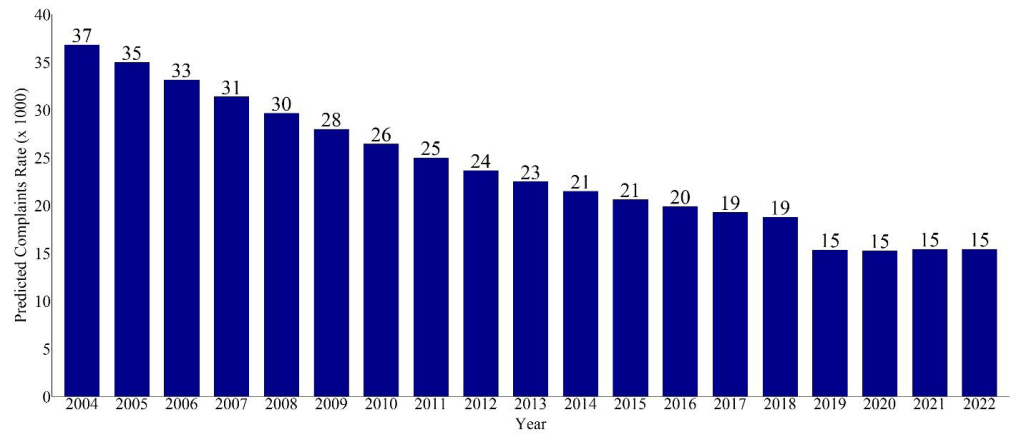
Notes: These predictions assume that Raise the Age was not passed. The total predicted number of complaints would be approximately 29,314 without the implementation of School Justice Partnerships, but 24,685 complaints with the implementation of School Justice Partnerships given a juvenile population of 1,542,851 youth age 6-17.
School Disciplinary Actions
In addition to keeping youth out of the juvenile justice system, School Justice Partnerships are intended to reduce the usage of school exclusionary punishments – e.g., short-term suspensions, long-term suspensions, and expulsions. These exclusionary punishments for school-based behaviors have been linked to future involvement in the juvenile and adult justice systems, highlighting the importance of reducing the usage of these punishments. The preliminary findings from the RTI study suggest that the implementation of a School Justice Partnership might not have a lasting impact on the usage of short-term suspensions, long-term suspensions, or expulsions. For example, the implementation of a School Justice Partnership was associated with an immediate reduction in the rate of long-term suspensions, but the effects were short-lived as the rate of long-term suspensions returns to the pre-implementation baseline 1 to 2 years after implementation. Moreover, the implementation of a School Justice Partnership had no effect on the rate of short-term suspensions or expulsions.
Implications
The preliminary findings provide suggest that the implementation of School Justice Partnerships reduces referrals to the juvenile justice system, but that the implementation of School Justice Partnerships do not have a lasting effect on the usage of suspensions and expulsions. Additional research is needed to understand how School Justice Partnerships function in practice – from newly launched partnerships to more mature ones; understand the challenges partners face and how challenges are addressed; and assess how partnerships maintain adherence or fidelity to the graduated response matrices. It could be that the promotion of the graduated response of disciplining school misconduct amongst teachers, staff, and school resource officers could reduce the usage of suspensions and expulsions. Additionally, more research could highlight the benefits of these partnerships beyond reducing referrals to the juvenile justice system (e.g., increased attendance, changes in student behavior). Moreover, with additional research, the benefits of existing School Justice Partnerships could be further enhanced, and learnings could shape the creation of new School Justice Partnerships that are implemented with fidelity. Broadly, these preliminary findings provide evidence to suggest that School Justice Partnerships achieve the desired goal of reducing youth contact with the juvenile justice system and signal the need for additional study to understand whether School Justice Partnerships can reduce youth experiences with suspension and expulsion.
Data & Methods
The current study relied on the county-level data released by the Division of Juvenile Justice and Delinquency Prevention within the North Carolina Department of Public Safety (NC DPS), school report cards data released by the North Carolina Department of Public Instruction (NC DPI), the School Justice Partnership information recorded by the North Carolina Administrative Office of the Courts (NC AOC), and the COVID-19 case and death information collected by the Centers for Disease Control and Prevention. The county-level rates of referral to the juvenile justice system were calculated as the total number of referrals divided by the number of individuals in the county between 6 and 17 years of age. The county-level rates of short-term suspension, long-term suspension, and expulsion were calculated as the total number of events recorded by schools serving individuals from 6th to 12th grade, divided by the total number of students enrolled in those schools. The effects of implementing a School Justice Partnership were estimated using multi-level interrupted time series models, adjusting for the effects of COVID-19, yearly trends, and the implementation of ‘Raise the Age’ legislation.
- Complaints, in the current context, included violent offenses and person offenses (e.g., robbery, kidnapping, attempted murder, etc.), felony offenses (e.g., serious property or weapons offenses), serious misdemeanors (e.g., assaults by youth ages 8 to 17 at time of offense), common misdemeanors (e.g., shoplifting, communicating threats, disorderly conduct at school, etc.), non-criminal violations of the law (e.g., motorcycle/moped violation, riding a bicycle/skating in a public area), and status offenses (i.e., truancy, running away from home, ungovernable)
- A short-term suspension is a suspension that lasts for 10-days or less, a long-term suspension is a suspension that lasts for 11 days or more.
- Novak, A. (2021). Trajectories of exclusionary discipline: Risk factors and associated outcomes. Journal of School Violence, 20(2), 182-194.
- Novak, A., & Fagan, A. (2022). Expanding research on the school-to-prison pipeline: Examining the relationships between suspension, expulsion, and recidivism among justice-involved youth. Crime & Delinquency, 68(1), 3-27.
- https://www.ncdps.gov/our-organization/juvenile-justice/community-programs/juvenile-crime-prevention-councils/jcpc-planning-process/county-databooks
- https://www.dpi.nc.gov/data-reports/school-report-cards/school-report-card-resources-researchers
- Middle schools (6th-8th grade), high schools (9th-12th grade), and schools that serviced students in grades K-12th grade, 6th-12th grade, and K-8th grade classified as “normal schools” were included in the calculation of the short-term suspension, long-term suspension, and expulsion rate.
- https://www.ncdps.gov/our-organization/juvenile-justice/juvenile-justice-overview/key-initiatives/raise-age-nc#:~:text=Effective%20Dec.,and%20education%20on%20this%20topic
 ianasilver.com